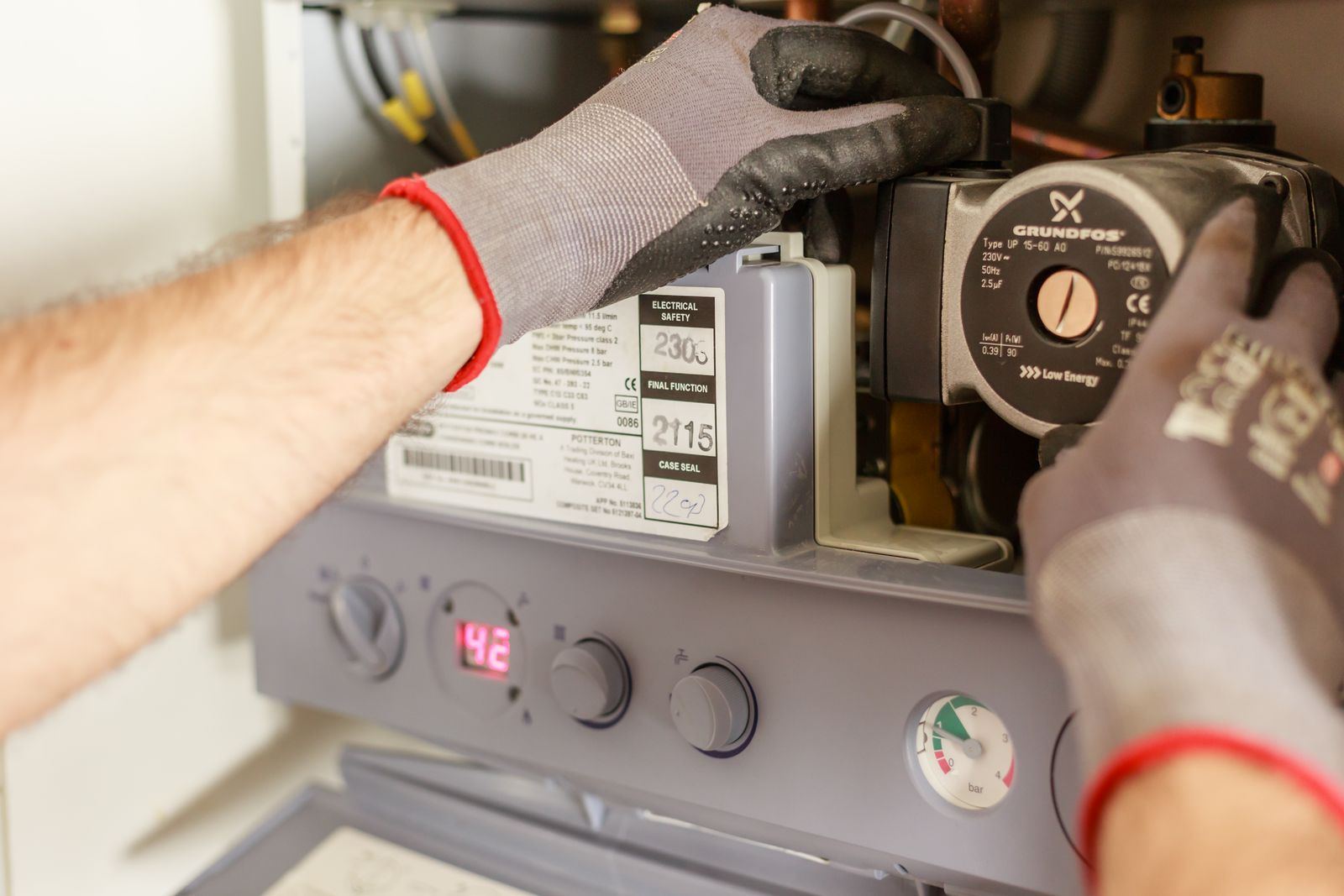
Tankless units are sophisticated machines, and that is both their strength and their weak spot. Instead of keeping forty or fifty gallons hot around the clock, a tankless heater springs into action only when water starts moving: a flow sensor detects demand, the control board fires the burner or elements, and water is heated on its way through the heat exchanger. Every step is watched by a sensor, and if any reading drifts outside its expected range, the board shuts the heater off and displays a code. For Reno, NV homeowners, that usually traces back to a short list of causes: scale building up inside the heat exchanger, a sticking or dirty flow sensor, an ignition problem at the igniter or flame rod, or a venting or gas supply issue the unit reads as unsafe.
Error codes are a starting point, not a diagnosis, and we treat them that way on every Reno call. The same ignition failure code can come from a worn igniter, a fouled flame rod, a gas line too small to feed the burner at full fire, or an air intake clogged with lint. That is why Reno Water Heater tests before replacing anything. Our technicians read the fault history stored in the control board, watch flow sensor output with a faucet open, measure flame signal and igniter resistance, and put a manometer on the gas inlet to see what pressure actually reaches the valve when the burner is running flat out. We also compare inlet and outlet temperatures against the flow rate, which reveals a scaled heat exchanger long before it fails outright.
The good news is that most tankless problems are very fixable. Scale can be flushed out, sensors and igniters are replaceable parts, and venting faults usually come down to a blocked intake or a loose joint. We carry common parts for the major brands and service both gas and electric units, so the typical repair is done in one trip. We are also honest about the harder cases: a unit fed by a gas line too small for its full BTU rating will keep throwing codes until the line is upsized, and a heat exchanger damaged by scale may not be worth repairing on an older heater. And if your complaint is the cold-water sandwich, that brief burst of cold between two hot draws, we will tell you whether it is normal for your model or something we can reduce. Is your tankless heater showing a code? Call (775) 314-3959 today.
What homeowners call us about most is Water Heater Repair in Reno. Either is a good place to start.
Warning Signs to Watch For
Most tanks announce trouble weeks or months ahead with rumbling noises, rusty water, or hot showers that keep getting shorter. Keep an eye out for the following:
- A heater that only fires when water runs at full blast
- Outlet temperature that surges and sags while water is running
- A combustion fan that sounds louder or rougher than normal
- A clicking igniter with no flame, or a flame that lights and quickly drops out
- Cold slugs in the middle of hot water that last longer than before
- Hot water that cannot keep up with more than one fixture
- Leaks under the unit or around its water connections
- A fault code on the front panel and no hot water
Act Before It Gets Worse
Tanks rarely fail all at once. They corrode from the inside for months, and the warning signs show up long before the floor gets wet. A quick call to (775) 314-3959 gets a technician out to check it before it becomes an emergency.
Tankless Water Heater Repair FAQ
Why Hire a Professional for Tankless Water Heater Repair?
Consider the risks first. A gas-fired tankless heater can burn nearly 200,000 BTU per hour at full fire, and its vent is the only thing carrying carbon monoxide out of the house; a joint that pulls loose or an intake that gets blocked changes that in a hurry. Electric tankless models are serious electrical loads, frequently more than 100 amps spread over several 240-volt circuits. Then there is the diagnostic puzzle. Error codes point to a system, not a part, so a flow sensor fault, a scaled heat exchanger, and a bad thermistor can look nearly identical on the display, and guessing gets expensive.
What you get from a professional is certainty. Instead of swapping parts, our technicians confirm the fault with a meter, a manometer, and temperature readings, so the fix is aimed at the actual cause. Descaling is done with a pump and service valves, not by pouring vinegar into an inlet and hoping. Gas pressure is checked with the burner at full output, vent runs are inspected against the manufacturer's length and clearance limits, and the unit is tested at low and high flow before we leave. Proper service also helps you stay within the manufacturer's warranty terms, many of which expect qualified service and regular descaling.
Our Tankless Water Heater Repair Process
Every visit follows a step-by-step method built around testing first and replacing parts only when the readings call for it. Here's a look at each step our team takes:
Code & Fault History Review
Codes get us started; measurements finish the job. Flow sensor output, flame signal, igniter resistance, inlet gas pressure, and vent condition all get checked before any part is replaced.
Plain Findings & Firm Quote
We show you the failed part, explain the cause, and give you a firm price before work begins. If scale has cracked the heat exchanger or the unit is near the end of its life, we say so plainly.
Same-Visit Fix
Most tankless repairs are finished in one trip: a descaling flush, a new flow sensor, igniter, or flame rod, a cleaned inlet screen, or a corrected vent connection.
Verified Temperature Rise
Before we pack up, we open fixtures at low and high flow, measure the temperature rise, and make sure the burner and vent perform at maximum output.
Want a Professional Opinion?
Tell us the age, fuel type, and symptoms, and we'll help you sort out the next step.
Get Help: (775) 314-3959Prevention Tips That Actually Help
A few preventive steps can help you avoid a cold shower or a wet floor down the road. Start with these practical measures our team relies on:
- Treat a code that returns after a reset as a symptom worth diagnosing, not ignoring
- Protect the heat exchanger with a softener or scale inhibitor when your water is hard
- Rinse the small filter screen on the cold inlet every few months
- Schedule a descaling flush every year; hard water may call for one every six months
- Tell us before adding a gas appliance, so the gas line can be checked for the extra load
- Make sure nothing blocks the exhaust vent or the air intake outside
- Leave the power on in cold weather, since freeze protection only runs when the unit has electricity
Should You DIY or Call a Pro?
Relighting a pilot by following the label is one thing. Diagnosing a gas valve, a burned-out element, a dirty flame sensor, or a tankless error code calls for meters and know-how that a pro brings. Here's how the two approaches stack up:
| Factor | Doing It Yourself | Hiring a Pro |
|---|---|---|
| Reading the Code | Look up the code and replace a guess | Fault history and live readings pinpoint it |
| Scale Removal | Partial flush that leaves scale behind | Full descale, then a thorough rinse |
| Combustion Safety | Gas pressure and vent joints unchecked | Combustion, venting, and gas supply checked |
| Electrical Work | Live wiring inside the cabinet | Circuits and board checked with proper tools |
| Parts | Wrong sensor ordered on a guess | Correct part for the exact model |
| Result | Temporary fix at best | Unit tested at low and high flow |
Book a Visit Today
Cold showers and damp floors don't get better on their own. Reno Water Heater can have a technician headed your way soon.
Tap to Call (775) 314-3959Tankless Water Heater Repair Near Reno
Our service area reaches well past the city limits. Choose your community for local details.